Showing posts with label history. Show all posts

Thursday, April 09, 2009

where popular phrases came from

here are some of the most popular phrases that people use often. but what do they mean and where did they come from?


"Houston, we have a problem..."

Meaning

Houston, we have a problemOriginally a genuine report of a life-threatening fault. Now used humorously to report any kind of problem.

Origin

John Swigert, Jr. and James Lovell who, with Fred Haise Jr., made up the crew of the US's Apollo 13 moon flight used (almost) this phrase to report a major technical problem back to their Houston base.

Swigert: 'Okay, Houston, we've had a problem here.'
Duke: 'This is Houston. Say again please.'
Lovell: 'Houston, we've had a problem. We've had a main B bus undervolt.'

The phrase was later used as the tagline for the 1995 film - Apollo 13.


"shiver my timbers!"

Meaning

An oath, expressing annoyance or surprise.

Origin

shiver me timbersThose of a certain age will remember Robert Newton, rolling his eyes and yarring it up in his archetypal Hollywood pirate role - Long John Silver in the 1950 film Treasure Island.

Robert Louis Stevenson used shiver my timbers several times in the original 1883 book, for example:

"Well, he [Old Pew] is dead now and under hatches; but for two year before that, shiver my timbers, the man was starving!"

Of course, Newton made the most of such 'parrot on the shoulder' phrases and it also appears several times in the film's screenplay. Newton's version, like that of all self-respecting stage pirates, was shiver me timbers, with the occasional 'aaarh, Jim lad' thrown in.

The first appearance of the phrase in print is in Frederick Marryat's Jacob Faithful, 1834:

"I won't thrash you Tom. Shiver my timbers if I do."

One meaning of shiver, which is now largely forgotten, is 'to break into pieces'. That meaning originated at least as early as the 14th century and is recorded in several Old English texts. A more recent citation, which makes that meaning clear, is James Froude's Caesar; a sketch, 1879:

"As he crossed the hall, his statue fell, and shivered on the stones."

So, the sailor's oath shiver my timbers, is synonymous with (if so and so happens then...) let my boat breaks into pieces. The question is whether any real sailor used the term or whether it was just a literary invention. Well, we can't be sure, although the fact that it actually means something and isn't just Newton-style hokum must count in favour of it being an authentic sailor's oath.


"i'm in a pickle!"

Meaning

In a quandary or some other difficult position.

Origin

This alludes to the pickling liquid made from brines and vinegar which is used to preserve food, and presumably to the imagined difficult of being stuck in such. The phrase was known in Dutch by 1561 - ' in de pekel zitten' meaning 'to be in a pickle'.

There are a few references to ill pickles and this pickle etc. in print in the late 16th century, but Shakespeare appears to be the first to use in a pickle, in The Tempest, 1611:

ALONSO:
And Trinculo is reeling ripe: where should they
Find this grand liquor that hath gilded 'em?
How camest thou in this pickle?

TRINCULO:
I have been in such a pickle since I
saw you last that, I fear me, will never out of
my bones: I shall not fear fly-blowing.


oops!! my bad!

Meaning

My mistake - I'm to blame.

Origin

This slang term originated in about 1970. At that time, i.e. pre the widespread use of the Internet, slang terms often circulated at street level for many years before being adopted by anyone who felt inclined to write them down. That's clearly not the case any longer of course and any word or phrase that is widely known is dateable quite precisely via website logs.

The first citation in print is C. Wielgus and A. Wolff's, 'Back-in-your-face Guide to Pick-up Basketball', 1986:

"My bad, an expression of contrition uttered after making a bad pass or missing an opponent."

clueless'My bad' came into widespread popular use in the mid to late-1990s in the USA via the 1995 movie “Clueless”. This starred Alicia Silverstone and contains what seems to have been the first use of the phrase in the mainstream media. The 1994 'Green revision pages' for the movie script has a scene with Alicia Silverstone's character learning to drive:

"Cher swerves - to avoid killing a person on a bicycle. Cher: Whoops, my bad."


Tuesday, February 24, 2009

10 technology predictions that was dead wrong

many apologies for the 2 months disappearance. so, let's get to it. one of my most favourite topics of all - technology. i love technology and i love how we're advancing at an exponential rate. it's a good time to be alive and enjoy the wonderful things we human beings have created.

it's amazing to me how people could live without the things we have now. i know that there are some new technology that we think that are useless and you'd think no one would ever use it. which brings me to the main topic. the people of the past... they had the same feeling. and even some of the brilliant minds were so confident with their thought on the technology of the past. but they were so wrong. so dead wrong. so read on.

1
let's start with something recent. the computer has been an important part of our lives. it consumes us and i personally have never gone a day without turning on my computer. but in 1977, Ken Olson (chairman and founder of Digital Equipment Corp) said, "there's no reason anyone would want a computer in their homes." so dead wrong.

2
“To place a man in a multi-stage rocket and project him into the controlling gravitational field of the moon where the passengers can make scientific observations, perhaps land alive, and then return to earth - all that constitutes a wild dream worthy of Jules Verne. I am bold enough to say that such a man-made voyage will never occur regardless of all future advances.” — Lee DeForest, American radio pioneer and inventor of the vacuum tube, in 1926. he was proven very wrong 5 years later.

3
“There will never be a bigger plane built.” — A Boeing engineer, after the first flight of the 247, a twin engine plane that holds ten people. thank goodness he was wrong.. imagine being cramped in with 9 other people. it'll be fun though if you were flying with your large family. a plane to yourselves. ':)

4
“The cinema is little more than a fad. It’s canned drama. What audiences really want to see is flesh and blood on the stage.” -– Charlie Chaplin, actor, producer, director, and studio founder, 1916. ironic that he even said that since cinema made him famous.

5
“The horse is here to stay but the automobile is only a novelty - a fad.” — The president of the Michigan Savings Bank advising Henry Ford’s lawyer, Horace Rackham, not to invest in the Ford Motor Co., 1903. one word - haha!

6
“How, sir, would you make a ship sail against the wind and currents by lighting a bonfire under her deck? I pray you, excuse me, I have not the time to listen to such nonsense.” — Napoleon Bonaparte, when told of Robert Fulton’s steamboat, 1800s. hmmm maybe if he'd listen to the guy, he'd won the war.

7
“[Television] won’t be able to hold on to any market it captures after the first six months. People will soon get tired of staring at a plywood box every night.” — Darryl Zanuck, movie producer, 20th Century Fox, 1946. a foolish foolish man.

8
“Dear Mr. President: The canal system of this country is being threatened by a new form of transportation known as ‘railroads’ … As you may well know, Mr. President, ‘railroad’ carriages are pulled at the enormous speed of 15 miles per hour by ‘engines’ which, in addition to endangering life and limb of passengers, roar and snort their way through the countryside, setting fire to crops, scaring the livestock and frightening women and children. The Almighty certainly never intended that people should travel at such breakneck speed.” — Martin Van Buren, Governor of New York, 1830(?). so freakin' funny...

9
“This ‘telephone’ has too many shortcomings to be seriously considered as a means of communication. The device is inherently of no value to us.” — A memo at Western Union, 1878 (or 1876). someone give him a Nokia.

10
and finally to the most recent one.. one of the richest man in the world today who was so bold to even predict this. but most funny of all it was about what he does best. why make it since i think it'll hurt himself?

“We will never make a 32 bit operating system.” — Bill Gates

thanks for the 64 bit operating system Mr. Gates. you really scared us there for a second.

so people, don't judge a new technology so hastily. it might come handy one day.
hope you had a good laugh everyone!

till next time.

Monday, April 28, 2008

Questions that popped in my head today

Have you ever had those moments when a question just popped into your head and you just sit there gazing into the distance? Then after an hour of wondering, you give up and HAVE to Google it? Then after another hour of finding it and reading about it you say to yourself, “ahhh.. now I can sleep easy tonight.”

What? Just me?

Anyway, here are some of those random questions popped into my head suddenly. My curiosities are usually triggered by watching TV, some are sudden realization in things I do routinely. So read on and delve into my weird mind and who knows.. I might answer some of your ‘popped questions’.


Why Apple (as in the iPod, Mac) is called Apple?


This came about while I was playing my iPod, of course.

The reason why Apple Computers are called that is so that it would, symbolically, come before rivals Atari in the phone book.

How did people with poor eye-sight see before glasses were invented?

This question popped into my head while watching Will & Grace.

Now this took me a while to find out but I was too curious to be satisfied with just one answer.

There are a few answers out there. Here are a few that I found and made sense to me.


1. There was no definite exact date of when glasses were invented and by whom. It was a technology that was developed over time. In an old transcript by a Roman, in 4 B.C., said that he was able to read “all” the books in Rome peering through a glass globe of water. Then there was Emperor Nero, watching gladiator matches with an emerald in front of his eye. But since the emerald was green, it could mean he used it to block out sunlight so that he could see well. Kind of like sun glasses.


Around 1000 A. D. the reading stone, what we know as a magnifying glass, was developed. It was a segment of a glass sphere that could be laid against reading material to magnify the letters. It enabled presbyopic monks to read and was probably the first reading aid. The Venetians learned how to produce glass for reading stones, and later they constructed lenses that could be held in a frame in front of the eyes instead of directly on the reading material. The Chinese are sometimes given credit for developing spectacles about 2000 years ago--but apparently they only used them to protect their eyes from an evil force. But even with all this information, the life expectancy in those days was 40 years-old. And sight deficiency doesn’t usually start until after that age.

Now you might be thinking, “I’m way younger than 40! And I have glasses as thick as the Hubble Telescope!” On to number 2.

2. Early sight-loss could be in the genes but most cases can be blamed to lighting. Either there’s not enough, like reading in a dim area or watching TV in the dark; or it could be because of too much light. With all the technology we have now, TV, computers, etc, our eyes are having a hard time coping and get very strained easily. Long hours in front of these artificial lights were not a daily ritual in the old days as it is today.

3.Glasses weren’t really ‘discovered’ until after the 16th century. So before then, literacy was a rare skill to have and the rich were the only ones that could afford books and if they lost their eye-sight, the Egyptians would used their slaves to read for them.


How much is it to advertise on Facebook?

I wondered about this when I was just checking my account and noticed the tiny advertising. So it got me thinking.. Since Facebook is so popular and costs over a billion dollars, the advert cost should be immense!

On the contrary it could be cheap, even normal people could advertise. I couldn’t find the exact number online so, I wore my journalist hat and went to the advertising section of Facebook. There, you can advertise almost anything. I tried to advertise this blog.


From there, I can choose which type of people I’m trying to target. Here, I chose any ages since my blog is family friendly. As you can see, you can choose your potential ‘targets’. (that’s how they use our profile details to get their money). Over 10 million people. Cool. It’s going to get me a lot of hits. J


Next, you choose your budget. It can be as low as $5.00. Then you choose how much you’re willing to pay per click.

Let’s say I chose to be cheap and will only pay just $5.00 and $0.01 per click, your advert will be on Facebook until your budget runs out. But since I was being very cheap, it could mean, my advert would pop up very rarely, making it rare for people to click on it. Or more often so that I’ll pay again for advertising. Now I get how online networking can be so lucrative. Anyone want to start one with me?

Okay, this post is getting too long now and I don’t like long posts. Look for part 2 in the near future. Hope you had a good read.

Tuesday, October 09, 2007

is king arthur real?

i have this friend, *li *m*ni (the 'A' in his name is not shown to protect his identity), he told me that king arthur was real. of course, i laughed thinking he was joking.


"i'm f*ckin' serious, dude" he said with a straight face. i remained quiet.

then i laughed louder than before. apparently, when he was a wee boy, his mommy brought him to a castle in winchester and there, they saw the legendary castle of camelot and the round table. well, today, i shall unravel the truth and myth of the mighty king, shattering my friend's dream and reveal his childhood memory was nothing but a lie.


king arthur. just a legend or a true hero?

first off, let's start with a brief 'history' of the magnificent king. king arthur was not ruling the east part of england but was more associated to cornwall. there are multiple time frames of his era, but it is around 367-734 AD. his origins is not known. some say he's british or roman. the earliest account of the reign of arthur was not documented until 200 years after the arthur era. so, this account is a long shot to the truth at best. but in 1998, this stone caused a stir.

In the north coast of Cornwall on cliffs overlooking the sea. In the 1100's this was recorded as the traditional birthplace of Arthur. In 1991 the first major excavation since the 1930's took place at Tintagel Castle directed by Professor Chris Morris of the University of Glasgow. In 1983 an excavation here found the remains of dozens of huts from the 400's. During the1998 excavation in August some evidence of a Runic inscription on a piece of rock of the 500's mentioning Arthur (Artognov) was located. The present day economy of Tintagel is closely built on the myth of King Arthur. Arthur's birth site is reputed to lie beneath the Norman castle.

the answer is not yet conclusive.


you may know the story of the sword in the stone.

"only a true king can pull this sword from the stone!" said merlin . then, a boy came and pulled it out and became king of camelot. it is said that the mythical sword could cut anything. the story doesn't just end there. according to historical accounts, he threw away excalibur when he accidentally killed a fellow knight but went on a quest to find a new sword and named it after the original.


as he was a great leader, he was also a great warrior. in a crucial battle with the invading anglo-saxons, he won the battle..... single-handedly, killing over 900 men.

now for the truth... where better to start than wikipedia.
King Arthur is a fabled Brython leader and a prominent figure in Britain's legendary history. A real individual may have been the inspiration of the legend, but later stories of Arthur are almost entirely fictional. In these he appears as the ideal of kingship both in war and peace; even in modern times he has been ranked as one of the 100 Greatest Britons of all time. Over time, the stories of King Arthur have captured such widespread interest that he is no longer identified as the legendary hero of a single nation. Countless new legends, stories, revisions, books, and films have been produced in Europe and the United States that unabashedly enlarge on and expand the fictional accounts of King Arthur.

most historians think that arthur were stories of many great leaders of the time, making him one great king. he was actually nothing more than a mere romantic story of a great king and his brave knights and round tables which was just used as a moral booster for pheasants and soldiers of the time. a big proof to this are the armours. during the alleged arthur era, weapons back then were simple. there were no knights in shinning armours on horses with metal swords. wooden spears would have been common and realistic during that period.

there's a lot more to it than what i described above but for your sake, i shall stop here. it's very long and some may find it dull.

but there was one more thing i needed to find out. what did my friend actually see when he was a kid? well, here it is...

this was just a replica of the famous king arthur's roundtable. and the king on the table is king henry VIII. kings and leaders of the knight era would use king arthur's brave stories in war cries before going into battle. so, it is not surprising that a roundtable is made to, again, boost morale.

hope you had a good read, *li!

Friday, September 07, 2007

the seven wonders of the world

this topic was brought on by my sister who asked me what are the wonders of the world.. being a major fan of civilization games, i thought i had the answer in the bag.

"well, there's the pyramids.. ummm.. the hanging gardens of babylons is another one.." then i stopped. those were the only two i knew. she told me that the wonders of the world keeps changing and now there more than seven. this caught my curiosity and had to find out. hence today's post.

i thought this was going to be an easy subject. "just google in seven wonders", i thought. well, on my quest to find the answer i found out that there are actually many types of wonders of the world. some of them are:

  • the seven wonders of the natural world
  • the seven wonders of the modern world
  • the seven underwater wonders of the world
  • the seven wonders of the medieval mind
there are even forgotten wonders of the world.

but the one i was actually interested and will share with you today are the seven wonders of the ancient world.

the great pyramids of giza

of course, when thinking of the world wonders, everyone would definitely know that the pyramids are one of them. being the only wonder that is still left standing here today, it is located in the city of giza, a necropolis of ancient memphis, and today part of greater cairo, egypt.

the great pyramid is believed to have been built over a 20 year period. the site was first prepared, and blocks of stone were transported and placed. an outer casing (which disappeared over the years) was then used to smooth the surface. although it is not known how the blocks were put in place, several theories have been proposed. one theory involves the construction of a straight or spiral ramp that was raised as the construction proceeded. this ramp, coated with mud and water, eased the displacement of the blocks which were pushed (or pulled) into place. a second theory suggests that the blocks were placed using long levers with a short angled foot.

interesting facts:
  • when it was built, the great pyramid was 145.75 m (481 ft) high. over the years, it lost 10m (30 ft) off its top.
  • it was the tallest structure in the world for more than 43 centuries!
  • it consists of more than 2 million blocks of stone each weighing more than 2 tons.


the hanging gardens of babylon

this wonder is actually a huge controversy. many think it didn't even exist because of a lack of documentation in the babylonian history book.

The Babylonian kingdom flourished under the rule of the famous King, Hammurabi (1792-1750 BC). It was not until the reign of Naboplashar (625-605 BC) of the Neo-Babylonian dynasty that the Mesopotamian civilization reached its ultimate glory. His son, Nebuchadnezzar II (604-562 BC) is credited for building the legendary Hanging Gardens. It is said that the Gardens were built by Nebuchadnezzar to please his wife or concubine who had been "brought up in Media and had a passion for mountain surroundings".

While the most descriptive accounts of the Gardens come from Greek historians such as Berossus and Diodorus Siculus, Babylonian records stay silent on the matter. Tablets from the time of Nebuchadnezzar do not have a single reference to the Hanging Gardens, although descriptions of his palace, the city of Babylon, and the walls are found. Even the historians who give detailed descriptions of the Hanging Gardens never saw them. Modern historians argue that when Alexander's soldiers reached the fertile land of Mesopotamia and saw Babylon, they were impressed. When they later returned to their rugged homeland, they had stories to tell about the amazing gardens and palm trees at Mesopotamia.. About the palace of Nebuchadnezzar.. About the Tower of Babel and the ziggurats. And it was the imagination of poets and ancient historians that blended all these elements together to produce one of the World Wonders.

here's a picture of what it might looked like.


the temple of artemis at ephesus

there were so many temples back then. why did this one made it into the world wonders? well, just look at what it looked like. beautiful..

Although the foundation of the temple dates back to the seventh century BC, the structure that earned a spot in the list of Wonders was built around 550 BC. Referred to as the great marble temple, or temple D, it was sponsored by the Lydian king Croesus and was designed by the Greek architect Chersiphron. It was decorated with bronze statues sculpted by the most skilled artists of their time: Pheidias, Polycleitus, Kresilas, and Phradmon.

The temple served as both a marketplace and a religious institution. For years, the sanctuary was visited by merchants, tourists, artisans, and kings who paid homage to the goddess by sharing their profits with her. Recent archeological excavations at the site revealed gifts from pilgrims including statuettes of Artemis made of gold and ivory... earrings, bracelets, and necklaces... artifacts from as far as Persia and India.

On the night of 21 July 356 BC, a man named Herostratus burned the temple to ground in an attempt to immortalize his name. He did indeed. Strangely enough, Alexander the Great was born the same night. The Roman historian Plutarch later wrote that the goddess was "too busy taking care of the birth of Alexander to send help to her threatened temple". Over the next two decades, the temple was restored and is labeled "temple E" by archeologists. And when Alexander the Great conquered Asia Minor, he helped rebuild the destroyed temple.

When St Paul visited Ephesus to preach Christianity in the first century AD, he was confronted by the Artemis' cult who had no plans to abandon their goddess. And when the temple was again destroyed by the Goths in AD 262, the Ephesians vowed to rebuild. By the fourth century AD, most Ephesians had converted to Christianity and the temple lost its religious glamor. The final chapter came when in AD 401 the Temple of Artemis was torn down by St John Chrysostom. Ephesus was later deserted, and only in the late nineteenth century has the site been excavated. The digging revealed the temple's foundation and the road to the now swampy site. Attempts were recently made to rebuilt the temple, but only a few columns have been re-erected.

what it is now...


the statue of zeus at olympia
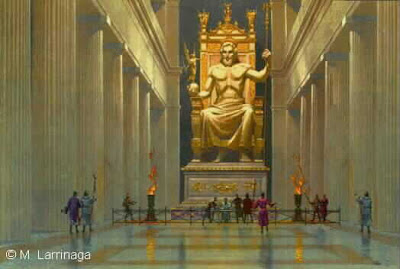
The ancient Greek calendar starts in 776 BC, for the Olympic games are believed to have started that year. The magnificent temple of Zeus was designed by the architect Libon and was built around 450 BC. Under the growing power of ancient Greece, the simple Doric-style temple seemed too mundane, and modifications were needed. The solution: A majestic statue. The Athenian sculptor Pheidias was assigned for the "sacred" task, reminiscent of Michelangelo's paintings at the Sistine Chapel.

For the years that followed, the temple attracted visitors and worshippers from all over the world. In the second century BC repairs were skillfully made to the aging statue. In the first century AD, the Roman emperor Caligula attempted to transport the statue to Rome. However, his attempt failed when the scaffolding built by Caligula's workmen collapsed. After the Olympic games were banned in AD 391 by the emperor Theodosius I as Pagan practices, the temple of Zeus was ordered closed.

Olympia was further struck by earthquakes, landslides and floods, and the temple was damaged by fire in the fifth century AD. Earlier, the statue had been transported by wealthy Greeks to a palace in Constantinople. There, it survived until it was destroyed by a severe fire in AD 462. Today nothing remains at the site of the old temple except rocks and debris, the foundation of the buildings, and fallen columns.


the mausoleum at halicarnassus
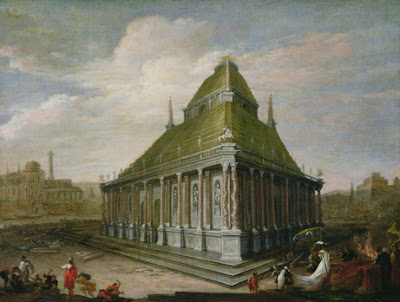
When the Persians expanded their ancient kingdom to include Mesopotamia, Northern India, Syria, Egypt, and Asia Minor, the king could not control his vast empire without the help of local governors or rulers -- the Satraps. Like many other provinces, the kingdom of Caria in the western part of Asia Minor (Turkey) was so far from the Persian capital that it was practically autonomous. From 377 to 353 BC, king Mausollos of Caria reigned and moved his capital to Halicarnassus. Nothing is exciting about Maussollos life except the construction of his tomb. The project was conceived by his wife and sister Artemisia, and the construction might have started during the king's lifetime. The Mausoleum was completed around 350 BC, three years after Maussollos death, and one year after Artemisia's.

For 16 centuries, the Mausoleum remained in good condition until an earthquake caused some damage to the roof and colonnade. In the early fifteenth century, the Knights of St John of Malta invaded the region and built a massive crusader castle. When they decided to fortify it in 1494, they used the stones of the Mausoleum. By 1522, almost every block of the Mausoleum had been disassembled and used for construction.

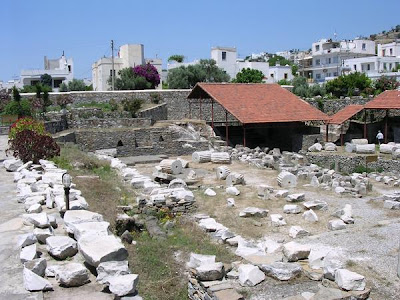
Today, the massive castle still stands in Bodrum, and the polished stone and marble blocks of the Mausoleum can be spotted within the walls of the structure. Some of the sculptures survived and are today on display at the British Museum in London. These include fragment of statues and many slabs of the frieze showing the battle between the Greeks and the Amazons. At the site of the Mausoleum itself, only the foundation remains of the once magnificent Wonder.

present day...

the colossus of rhodes
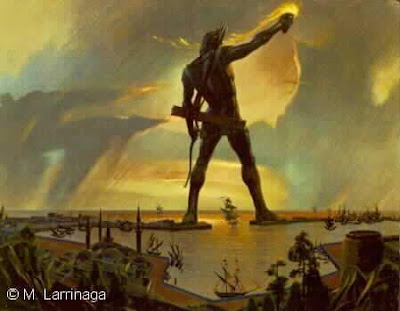
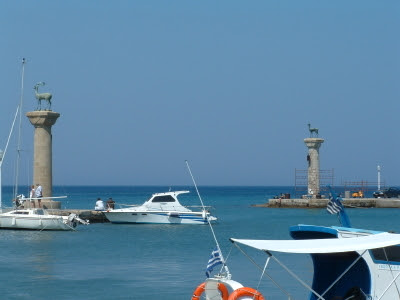
Throughout most of its history, ancient Greece was comprised of city-states which had limited power beyond their boundary. On the small island of Rhodes were three of these: Ialysos, Kamiros, and Lindos. In 408 BC, the cities united to form one territory, with a unified capital, Rhodes. The city thrived commercially and had strong economic ties with their main ally, Ptolemy I Soter of Egypt. In 305 BC, the Antigonids of Macedonia who were also rivals of the Ptolemies, besieged Rhodes in an attempt to break the Rhodo-Egyptian alliance. They could never penetrate the city. When a peace agreement was reached in 304 BC, the Antagonids lifted the siege, leaving a wealth of military equipment behind. To celebrate their unity, the Rhodians sold the equipment and used the money to erect an enormous statue of their sun god, Helios.

The construction of the Colossus took 12 years and was finished in 282 BC. For years, the statue stood at the harbor entrance, until a strong earthquake hit Rhodes about 226 BC. The city was badly damaged, and the Colossus was broken at its weakest point -- the knee. The Rhodians received an immediate offer from Ptolemy III Eurgetes of Egypt to cover all restoration costs for the toppled monument. However, an oracle was consulted and forbade the re-erection. Ptolemy's offer was declined.

For almost a millennium, the statue laid broken in ruins. In AD 654, the Arabs invaded Rhodes. They disassembled the remains of the broken Colossus and sold them to a Jew from Syria. It is said that the fragments had to be transported to Syria on the backs of 900 camels.

this is a picture of where the colossus might have been built on. see those two deers, that's where the feet were.

last but definitely not least is the...


the lighthouse of alexandria

Shortly after the death of Alexander the Great, his commander Ptolemy Soter assumed power in Egypt. He had witnessed the founding of Alexandria, and established his capital there. Off of the city's coast lies a small island: Pharos. Its name, legend says, is a variation of Pharaoh's Island. The island was connected to the mainland by means of a dike - the Heptastadion - which gave the city a double harbor. And because of dangerous sailing conditions and flat coastline in the region, the construction of a lighthouse was necessary.

The monument was dedicated to the Savior Gods: Ptolemy Soter (lit. savior) and his wife Berenice. For centuries, the Lighthouse of Alexandria (occasionally referred to as the Pharos Lighthouse) was used to mark the harbor, using fire at night and reflecting sun rays during the day. It was even shown on Roman coins, just as famous monuments are depicted on currency today.

When the Arabs conquered Egypt, they admired Alexandria and its wealth. The Lighthouse continues to be mentioned in their writings and travelers accounts. But the new rulers moved their capital to Cairo since they had no ties to the Mediterranean. When the mirror was brought down mistakenly, they did not restore it back into place. In AD 956, an earthquake shook Alexandria, and caused little damage to the Lighthouse. It was later in 1303 and in 1323 that two stronger earthquakes left a significant impression on the structure. When the famous Arab traveler Ibn Battuta visited Alexandria in 1349, he could not enter the ruinous monument or even climb to its doorway.

The final chapter in the history of the Lighthouse came in AD 1480 when the Egyptian Mamelouk Sultan, Qaitbay, decided to fortify Alexandria's defense. He built a medieval fort on the same spot where the Lighthouse once stood, using the fallen stone and marble.

hope you enjoyed learning something new today.. or old rather.. and hopefully that answers your question my dear sister.