Showing posts with label internet. Show all posts

Monday, December 15, 2008

people prefer internet over sex

Intel came up with a novel way to show how important the Internet and computing have become in the lives of Americans. In conjunction with Harris Interactive, the company conducted a survey of adults in the United States under the prosaic-enough banner “Internet Reliance in Today’s Economy.” But the first “key finding” from the study is a little more attention-grabbing. According to the study, 46 percent of women and 30 percent of men would opt to forgo sex for two weeks instead of giving up access to their precious Internet for the same period. More broadly, those surveyed said access to the Internet ranked highest among the discretionary spending items they could not live without. Cable television, dining out, shopping for clothes and gym memberships followed in declining importance.

Along similar lines, 61 percent of the women surveyed said they would rather go without TV for two weeks than lose access to the Internet for one week. Using the data as a means of pitching products fueled by Intel chips, the company said: “The survey revealed that 65 percent of adults feel they cannot live without Internet access, and even more — 71 percent — responded that it is important or very important to have Internet-enabled devices, such as laptops, netbooks and mobile Internet devices that can provide them with real-time updates on important issues including the state of the economy.” Harris Interactive polled 2,119 adults on Intel’s behalf.

source: NY Times

Monday, April 28, 2008

Questions that popped in my head today

Have you ever had those moments when a question just popped into your head and you just sit there gazing into the distance? Then after an hour of wondering, you give up and HAVE to Google it? Then after another hour of finding it and reading about it you say to yourself, “ahhh.. now I can sleep easy tonight.”

What? Just me?

Anyway, here are some of those random questions popped into my head suddenly. My curiosities are usually triggered by watching TV, some are sudden realization in things I do routinely. So read on and delve into my weird mind and who knows.. I might answer some of your ‘popped questions’.


Why Apple (as in the iPod, Mac) is called Apple?


This came about while I was playing my iPod, of course.

The reason why Apple Computers are called that is so that it would, symbolically, come before rivals Atari in the phone book.

How did people with poor eye-sight see before glasses were invented?

This question popped into my head while watching Will & Grace.

Now this took me a while to find out but I was too curious to be satisfied with just one answer.

There are a few answers out there. Here are a few that I found and made sense to me.


1. There was no definite exact date of when glasses were invented and by whom. It was a technology that was developed over time. In an old transcript by a Roman, in 4 B.C., said that he was able to read “all” the books in Rome peering through a glass globe of water. Then there was Emperor Nero, watching gladiator matches with an emerald in front of his eye. But since the emerald was green, it could mean he used it to block out sunlight so that he could see well. Kind of like sun glasses.


Around 1000 A. D. the reading stone, what we know as a magnifying glass, was developed. It was a segment of a glass sphere that could be laid against reading material to magnify the letters. It enabled presbyopic monks to read and was probably the first reading aid. The Venetians learned how to produce glass for reading stones, and later they constructed lenses that could be held in a frame in front of the eyes instead of directly on the reading material. The Chinese are sometimes given credit for developing spectacles about 2000 years ago--but apparently they only used them to protect their eyes from an evil force. But even with all this information, the life expectancy in those days was 40 years-old. And sight deficiency doesn’t usually start until after that age.

Now you might be thinking, “I’m way younger than 40! And I have glasses as thick as the Hubble Telescope!” On to number 2.

2. Early sight-loss could be in the genes but most cases can be blamed to lighting. Either there’s not enough, like reading in a dim area or watching TV in the dark; or it could be because of too much light. With all the technology we have now, TV, computers, etc, our eyes are having a hard time coping and get very strained easily. Long hours in front of these artificial lights were not a daily ritual in the old days as it is today.

3.Glasses weren’t really ‘discovered’ until after the 16th century. So before then, literacy was a rare skill to have and the rich were the only ones that could afford books and if they lost their eye-sight, the Egyptians would used their slaves to read for them.


How much is it to advertise on Facebook?

I wondered about this when I was just checking my account and noticed the tiny advertising. So it got me thinking.. Since Facebook is so popular and costs over a billion dollars, the advert cost should be immense!

On the contrary it could be cheap, even normal people could advertise. I couldn’t find the exact number online so, I wore my journalist hat and went to the advertising section of Facebook. There, you can advertise almost anything. I tried to advertise this blog.


From there, I can choose which type of people I’m trying to target. Here, I chose any ages since my blog is family friendly. As you can see, you can choose your potential ‘targets’. (that’s how they use our profile details to get their money). Over 10 million people. Cool. It’s going to get me a lot of hits. J
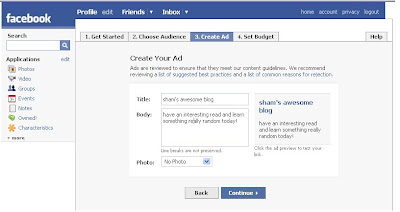

Next, you choose your budget. It can be as low as $5.00. Then you choose how much you’re willing to pay per click.

Let’s say I chose to be cheap and will only pay just $5.00 and $0.01 per click, your advert will be on Facebook until your budget runs out. But since I was being very cheap, it could mean, my advert would pop up very rarely, making it rare for people to click on it. Or more often so that I’ll pay again for advertising. Now I get how online networking can be so lucrative. Anyone want to start one with me?

Okay, this post is getting too long now and I don’t like long posts. Look for part 2 in the near future. Hope you had a good read.

Monday, April 07, 2008

death by blogging

that's right.. people have actually died from blogging! i found this really scary article from the NY times.


Some of the blogging community are worried that blogging could be bad for your health. The constant need to publish new and exciting facts is putting stress on successful bloggers, and the recent deaths from heart attacks of three popular writers is causing something of a rethink in the industry. “I haven’t died yet,” Michael Arrington, founder and co-editor of TechCrunch, told The New York Times. “At some point, I’ll have a nervous breakdown and be admitted to hospital, or something else will happen. This is not sustainable.”


Arrington claimed that he has gained 30 pounds and developed a severe sleeping disorder over the past three years as a result of his job. Two other technology bloggers, Russell Shaw, 60, and Marc Orchant, 50, have died of heart failures. While blogging has not been directly linked to their deaths, the stress of churning out thousands of words a day may have been a factor. “There is no time ever, including when you’re sleeping, when you’re not worried about missing a story,” said Arrington. “Wouldn’t it be great if we said that no blogger or journalist could write a story between 8pm Pacific time and dawn? Then we could all take a break. But that’s never going to happen.”

scary..

Monday, August 20, 2007

the world wide web

let's start things off with something that has become a major part of our lives, especially to IT generation of today - the internet. what started out as a military advantage in the 50's has become this exploding phenomenon, a source of all sources. i shall share with you the origins, the effects it has on us at present day and my personal take on the future for this fascinating tool. then, for those who has been wondering what website rules the web now, i shall reveal the top 10 websites of today. facebook, you think? read on and see...


origins
after the launch of USSR's sputnik, the US got a bit nervous and created Advanced Research Projects Agency, known as ARPA, in february 1958 to regain a technological lead. ARPA created the Information Processing Technology Office (IPTO) to further the research of the Semi Automatic Ground Environment (SAGE) program, which had networked country-wide radar systems together for the first time. J. C. R. Licklider was selected to head the IPTO, and saw universal networking as a potential unifying human revolution. he then moved the project from Harvard University to MIT, where he bought the first production PDP-1 computer and conducted the first public demonstration of time-sharing.
note: time-sharing refers to sharing a computing resource among many users by multitasking.
this was a revolution in terms of military information. this meant that highly classified information was not stored at just one place, which will make it an easy target by potential enemies. the information is spread out simultaneously, making it highly robust and survivable.
After much work, the first node went live at UCLA on october 29, 1969, on what would be called the ARPANET, one of the "eve" networks of today's internet.
insert: J. C. R. Licklider. USSR's Sputnik. right: PDP - 1


going online today
the growth of the internet today has exploded into the latest craze. it is the newest wave of communication through electronic mail, file transfer, telnet access, transaction applications, and much much more. the popularity of the internet has launched many social and ethical issues. recently, the internet has been critizied for its uncensored information, but has been praised for its educational value. personally, i think is one of the best invention man has ever created. as mentioned before, it is a huge source of information. some, unfortunately, are bad but most are essential, which we can learn from. it is also used for convenience. shoppings can be done at home, socializing is extended even further from using a telephone, banking has been made easier online. almost everything can be done at a click of a mouse now. granted, being cooped up at home isn't a healthy thing to do but the internet has made the world smaller. but what about the future? can it be any better than what it is today?


the future
on january 2005, a survey was made, where technology experts and scholars evaluate the where the network is headed in the next 10 years. the survey finds there is a strong across-the-board consensus that the internet will become so important to users in the coming decade that the network itself will become an inviting target for attack. by a nearly 3-1 margin, the experts in the survey expressed worry about the vulnerability of the internet and the likelihood of an attack on the underlying infrastructure within the next ten years.
Some 66% agreed with the following prediction: At least one devastating attack will occur in the next 10 years on the networked information infrastructure or the country’s power grid. obviously, the attack would of viral nature. a very scary start to the survey, i think. but some interesting predictions from the report are as follows:
  • 57% of them agreed that virtual classes will become more widespread in formal education and that students might at least occasionally be grouped with others who share their interests and skills, rather than by age.
  • 59% of these experts agreed with a prediction that more government and business surveillance will occur as computing devices proliferate and become embedded in appliances, cars, phones, and even clothes.
  • 56% of them agreed that as telecommuting and home-schooling expand, the boundary between work and leisure will diminish and family dynamics will change because of that.
  • 50% of them believe that anonymous, free, music file-sharing on peer-to-peer networks will still be easy to perform a decade from now.
for the full report, click here.

okay! enough seriousness and let's move on to the top websites of today! (note: rankings change constantly. the following may not be what you've discovered a few hours from now.)
extra note: (scope measures the number of Internet users visiting a particular site. ex: example.com has a scope of 7% - meaning an average of 70,000 (per million) users visit this site.)

10. youtube.com - it's not surprising really. with millions of videos ranging from music videos and documentaries to just silly randomness uploaded by a bored teenager.
today's scope: 7.93%

9. aol.com - personally, i don't use this site. basically, it's america's msn/yahoo.
today's scope: 6.91%

8. ebay.com - who doesn't know ebay? a successful website that started the internet shopping craze. got something you don't need and want to sell it without opening a shop? ebay is the answer.
today's scope: 6.5%

7. websearch.com - a new find for me, really. can't decide whether to use google, msn or ask.com? this could be the one for you. it uses up to 15 of the most popular search engines at once! i might give it a try.
today's scope: 9.51%

6. facebook.com - yes, that's right people. your precious online profile site isn't the best. hah! (this is coming from a guy who's not sucked in like the rest of you.) but i might eat my words soon though.. in the last 3 months, the scope has risen by 2.12%.
today's scope: 11.34% (damn..)

5. live.com - another search engine made by microsoft. apparently a very popular one to use.
today's scope: 18.2%

4. google.com - again a search engine. you guys know what it is..
today's scope: 21.15%

3. msn.com - beginning to see a pattern here..
today's scope: 26.54%

2. yahoo.com - starting to lose interest? don't just yet! no. 1 is coming up!
today's scope: 33.1%

1. myspace.com - yup. the online profile that gave birth to friendster and facebook. the is site dedicated to share photos, journals and interests with growing network of mutual friends. mostly musicians in the beginning, it has now become the top website by internet users.
today's scope: 20.99%

want to know your personal favourite web site's ranking? click here and find out for yourself!

hope you enjoyed the read.