Saturday, September 08, 2007

prison dancers and the chasers

i stumbled on this in youtube last night. hahaha! i had to share with you guys.


i found out that it was actually featured on cnn. so, i did some searching for more information on these awesome dancers and i was very fortunate to find these guys.


Friday, September 07, 2007

the seven wonders of the world

this topic was brought on by my sister who asked me what are the wonders of the world.. being a major fan of civilization games, i thought i had the answer in the bag.

"well, there's the pyramids.. ummm.. the hanging gardens of babylons is another one.." then i stopped. those were the only two i knew. she told me that the wonders of the world keeps changing and now there more than seven. this caught my curiosity and had to find out. hence today's post.

i thought this was going to be an easy subject. "just google in seven wonders", i thought. well, on my quest to find the answer i found out that there are actually many types of wonders of the world. some of them are:

  • the seven wonders of the natural world
  • the seven wonders of the modern world
  • the seven underwater wonders of the world
  • the seven wonders of the medieval mind
there are even forgotten wonders of the world.

but the one i was actually interested and will share with you today are the seven wonders of the ancient world.

the great pyramids of giza

of course, when thinking of the world wonders, everyone would definitely know that the pyramids are one of them. being the only wonder that is still left standing here today, it is located in the city of giza, a necropolis of ancient memphis, and today part of greater cairo, egypt.

the great pyramid is believed to have been built over a 20 year period. the site was first prepared, and blocks of stone were transported and placed. an outer casing (which disappeared over the years) was then used to smooth the surface. although it is not known how the blocks were put in place, several theories have been proposed. one theory involves the construction of a straight or spiral ramp that was raised as the construction proceeded. this ramp, coated with mud and water, eased the displacement of the blocks which were pushed (or pulled) into place. a second theory suggests that the blocks were placed using long levers with a short angled foot.

interesting facts:
  • when it was built, the great pyramid was 145.75 m (481 ft) high. over the years, it lost 10m (30 ft) off its top.
  • it was the tallest structure in the world for more than 43 centuries!
  • it consists of more than 2 million blocks of stone each weighing more than 2 tons.


the hanging gardens of babylon

this wonder is actually a huge controversy. many think it didn't even exist because of a lack of documentation in the babylonian history book.

The Babylonian kingdom flourished under the rule of the famous King, Hammurabi (1792-1750 BC). It was not until the reign of Naboplashar (625-605 BC) of the Neo-Babylonian dynasty that the Mesopotamian civilization reached its ultimate glory. His son, Nebuchadnezzar II (604-562 BC) is credited for building the legendary Hanging Gardens. It is said that the Gardens were built by Nebuchadnezzar to please his wife or concubine who had been "brought up in Media and had a passion for mountain surroundings".

While the most descriptive accounts of the Gardens come from Greek historians such as Berossus and Diodorus Siculus, Babylonian records stay silent on the matter. Tablets from the time of Nebuchadnezzar do not have a single reference to the Hanging Gardens, although descriptions of his palace, the city of Babylon, and the walls are found. Even the historians who give detailed descriptions of the Hanging Gardens never saw them. Modern historians argue that when Alexander's soldiers reached the fertile land of Mesopotamia and saw Babylon, they were impressed. When they later returned to their rugged homeland, they had stories to tell about the amazing gardens and palm trees at Mesopotamia.. About the palace of Nebuchadnezzar.. About the Tower of Babel and the ziggurats. And it was the imagination of poets and ancient historians that blended all these elements together to produce one of the World Wonders.

here's a picture of what it might looked like.


the temple of artemis at ephesus

there were so many temples back then. why did this one made it into the world wonders? well, just look at what it looked like. beautiful..

Although the foundation of the temple dates back to the seventh century BC, the structure that earned a spot in the list of Wonders was built around 550 BC. Referred to as the great marble temple, or temple D, it was sponsored by the Lydian king Croesus and was designed by the Greek architect Chersiphron. It was decorated with bronze statues sculpted by the most skilled artists of their time: Pheidias, Polycleitus, Kresilas, and Phradmon.

The temple served as both a marketplace and a religious institution. For years, the sanctuary was visited by merchants, tourists, artisans, and kings who paid homage to the goddess by sharing their profits with her. Recent archeological excavations at the site revealed gifts from pilgrims including statuettes of Artemis made of gold and ivory... earrings, bracelets, and necklaces... artifacts from as far as Persia and India.

On the night of 21 July 356 BC, a man named Herostratus burned the temple to ground in an attempt to immortalize his name. He did indeed. Strangely enough, Alexander the Great was born the same night. The Roman historian Plutarch later wrote that the goddess was "too busy taking care of the birth of Alexander to send help to her threatened temple". Over the next two decades, the temple was restored and is labeled "temple E" by archeologists. And when Alexander the Great conquered Asia Minor, he helped rebuild the destroyed temple.

When St Paul visited Ephesus to preach Christianity in the first century AD, he was confronted by the Artemis' cult who had no plans to abandon their goddess. And when the temple was again destroyed by the Goths in AD 262, the Ephesians vowed to rebuild. By the fourth century AD, most Ephesians had converted to Christianity and the temple lost its religious glamor. The final chapter came when in AD 401 the Temple of Artemis was torn down by St John Chrysostom. Ephesus was later deserted, and only in the late nineteenth century has the site been excavated. The digging revealed the temple's foundation and the road to the now swampy site. Attempts were recently made to rebuilt the temple, but only a few columns have been re-erected.

what it is now...


the statue of zeus at olympia
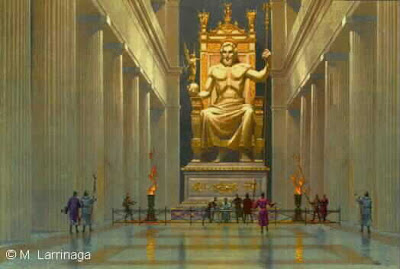
The ancient Greek calendar starts in 776 BC, for the Olympic games are believed to have started that year. The magnificent temple of Zeus was designed by the architect Libon and was built around 450 BC. Under the growing power of ancient Greece, the simple Doric-style temple seemed too mundane, and modifications were needed. The solution: A majestic statue. The Athenian sculptor Pheidias was assigned for the "sacred" task, reminiscent of Michelangelo's paintings at the Sistine Chapel.

For the years that followed, the temple attracted visitors and worshippers from all over the world. In the second century BC repairs were skillfully made to the aging statue. In the first century AD, the Roman emperor Caligula attempted to transport the statue to Rome. However, his attempt failed when the scaffolding built by Caligula's workmen collapsed. After the Olympic games were banned in AD 391 by the emperor Theodosius I as Pagan practices, the temple of Zeus was ordered closed.

Olympia was further struck by earthquakes, landslides and floods, and the temple was damaged by fire in the fifth century AD. Earlier, the statue had been transported by wealthy Greeks to a palace in Constantinople. There, it survived until it was destroyed by a severe fire in AD 462. Today nothing remains at the site of the old temple except rocks and debris, the foundation of the buildings, and fallen columns.


the mausoleum at halicarnassus
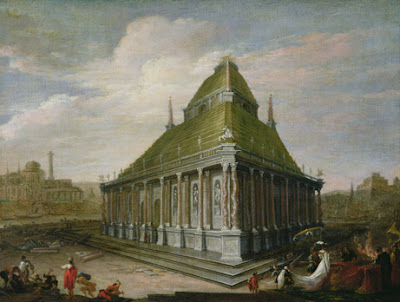
When the Persians expanded their ancient kingdom to include Mesopotamia, Northern India, Syria, Egypt, and Asia Minor, the king could not control his vast empire without the help of local governors or rulers -- the Satraps. Like many other provinces, the kingdom of Caria in the western part of Asia Minor (Turkey) was so far from the Persian capital that it was practically autonomous. From 377 to 353 BC, king Mausollos of Caria reigned and moved his capital to Halicarnassus. Nothing is exciting about Maussollos life except the construction of his tomb. The project was conceived by his wife and sister Artemisia, and the construction might have started during the king's lifetime. The Mausoleum was completed around 350 BC, three years after Maussollos death, and one year after Artemisia's.

For 16 centuries, the Mausoleum remained in good condition until an earthquake caused some damage to the roof and colonnade. In the early fifteenth century, the Knights of St John of Malta invaded the region and built a massive crusader castle. When they decided to fortify it in 1494, they used the stones of the Mausoleum. By 1522, almost every block of the Mausoleum had been disassembled and used for construction.

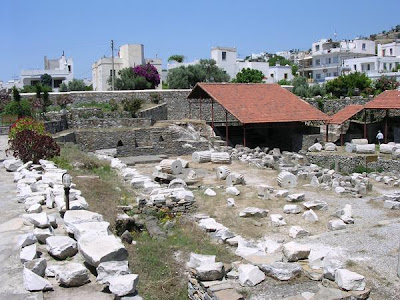
Today, the massive castle still stands in Bodrum, and the polished stone and marble blocks of the Mausoleum can be spotted within the walls of the structure. Some of the sculptures survived and are today on display at the British Museum in London. These include fragment of statues and many slabs of the frieze showing the battle between the Greeks and the Amazons. At the site of the Mausoleum itself, only the foundation remains of the once magnificent Wonder.

present day...

the colossus of rhodes
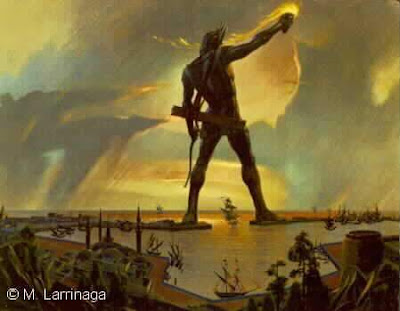
Throughout most of its history, ancient Greece was comprised of city-states which had limited power beyond their boundary. On the small island of Rhodes were three of these: Ialysos, Kamiros, and Lindos. In 408 BC, the cities united to form one territory, with a unified capital, Rhodes. The city thrived commercially and had strong economic ties with their main ally, Ptolemy I Soter of Egypt. In 305 BC, the Antigonids of Macedonia who were also rivals of the Ptolemies, besieged Rhodes in an attempt to break the Rhodo-Egyptian alliance. They could never penetrate the city. When a peace agreement was reached in 304 BC, the Antagonids lifted the siege, leaving a wealth of military equipment behind. To celebrate their unity, the Rhodians sold the equipment and used the money to erect an enormous statue of their sun god, Helios.

The construction of the Colossus took 12 years and was finished in 282 BC. For years, the statue stood at the harbor entrance, until a strong earthquake hit Rhodes about 226 BC. The city was badly damaged, and the Colossus was broken at its weakest point -- the knee. The Rhodians received an immediate offer from Ptolemy III Eurgetes of Egypt to cover all restoration costs for the toppled monument. However, an oracle was consulted and forbade the re-erection. Ptolemy's offer was declined.

For almost a millennium, the statue laid broken in ruins. In AD 654, the Arabs invaded Rhodes. They disassembled the remains of the broken Colossus and sold them to a Jew from Syria. It is said that the fragments had to be transported to Syria on the backs of 900 camels.

this is a picture of where the colossus might have been built on. see those two deers, that's where the feet were.
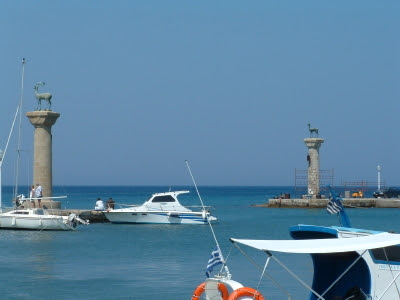

last but definitely not least is the...


the lighthouse of alexandria

Shortly after the death of Alexander the Great, his commander Ptolemy Soter assumed power in Egypt. He had witnessed the founding of Alexandria, and established his capital there. Off of the city's coast lies a small island: Pharos. Its name, legend says, is a variation of Pharaoh's Island. The island was connected to the mainland by means of a dike - the Heptastadion - which gave the city a double harbor. And because of dangerous sailing conditions and flat coastline in the region, the construction of a lighthouse was necessary.

The monument was dedicated to the Savior Gods: Ptolemy Soter (lit. savior) and his wife Berenice. For centuries, the Lighthouse of Alexandria (occasionally referred to as the Pharos Lighthouse) was used to mark the harbor, using fire at night and reflecting sun rays during the day. It was even shown on Roman coins, just as famous monuments are depicted on currency today.

When the Arabs conquered Egypt, they admired Alexandria and its wealth. The Lighthouse continues to be mentioned in their writings and travelers accounts. But the new rulers moved their capital to Cairo since they had no ties to the Mediterranean. When the mirror was brought down mistakenly, they did not restore it back into place. In AD 956, an earthquake shook Alexandria, and caused little damage to the Lighthouse. It was later in 1303 and in 1323 that two stronger earthquakes left a significant impression on the structure. When the famous Arab traveler Ibn Battuta visited Alexandria in 1349, he could not enter the ruinous monument or even climb to its doorway.

The final chapter in the history of the Lighthouse came in AD 1480 when the Egyptian Mamelouk Sultan, Qaitbay, decided to fortify Alexandria's defense. He built a medieval fort on the same spot where the Lighthouse once stood, using the fallen stone and marble.

hope you enjoyed learning something new today.. or old rather.. and hopefully that answers your question my dear sister.

Saturday, September 01, 2007

it's morphin' time!

as promised, i've come back with a good-read post. it still is as random as my other posts but this one has a sentimental value for me and to those of you who were just a young child in the early 90's. i'm not quite sure how this post came about. it suddenly just popped in my head and i HAD to find out the answers. it's the original power rangers. i remember telling my brother to tape the show cause it aired in the afternoon during my ugama school (religious school) and i'd watch it afterwards. i spent hours playing as the red ranger with my brother being the green ranger. sigh.. memories. but it's been 13 years now. what ever happened to those powerful characters? if you're curious, read on.

red ranger (jason) - austin st. john
after leaving the cast midway through the second season, he has been in a few movies, the last one was in 2003 called footsteps. he wrote a book and made a video, both on martial arts. currently, he's 31 and in Washington DC working as a paramedic. get a load of his picture now.

black ranger (zach) - walter emmanuel jones


like austin, he also left the show in season 2 due to disagreement in wages. he continues to dabble in acting, most notably having a recurring role in FX's The Shield during its first season. he did a few things after he left the show. he did voice-overs for a villain, ironically enough, in the show that he left and also as the main character in a video game, freedom fighters. his current passion is salsa dancing and was the 2004 Mayan International Salsa Championship. he still keeps in touch with austin, his best-friend. click here for his own website.
blue ranger (billy) - david yost
david yost was the only ranger to have been in every episode of the original power rangers. after the 4th season, his role in the show was reduced to a mere advisor to the new rangers. dissatisfied with the new role and the pay that went along with it, he left the show. since then, he moved behind the camera and has worked as a producer for Sci-Fi Lab (a division of Sci-Fi Channel) and manager of licensing for Pioneer Entertainment (selling completed television shows to networks). he is now 38.

pink ranger (kimberly) - amy jo johnson
the most active of them all after the power ranger hoopla, she has kept herself very busy by getting as much media exposure as she could. she guest-starred in another 90's favourite, saved by the bell, in a small role. then, she worked with disney and was a star in a 1996 movie, susie q. she landed a major role in a series, felicity, where she learned to play guitar. she then had a band called, the amy jo johnson band but later disbanded and since then preformed acoustically. now 36, she has her own website dedicated to her music. click here for her site and here for her myspace page.

green/white ranger (tommy) - jason david frank
frank is the longest appearing male power ranger, while amy jo was the female to appear for the longest time. he appeared in the most power rangers episodes, 257 character appearances and 242 actual appearances. he also appeared in the most seasons: seven (Mighty Morphin [3], Zeo, Turbo, Wild Force and Dino Thunder). since then, he made a lot of tv appearances and made a couple of movies but he starred in his last one, fall guy (2006). now 33, he's been married twice and have 5 kids.

yellow ranger (trini) - thuy trang

it is unfortunate to tell you that thuy trang died from a car crash on september 3rd 2001. she and former actress/model Angela Rockwood-Nguyen, to whom Trang was to be a bridesmaid to later that year, were passengers in a car traveling on Interstate 5 between San Francisco and Los Angeles (they were returning from visiting Angela's planned maid of honor) when the driver (another of Angela's bridesmaids) of the vehicle she was riding in lost control. The car swerved violently across the road before hitting the roadside rock face and flipping several times before hitting the safety rail and plunging over the bank. Rockwood-Nguyen, who has claimed she was wearing a seat belt[1], survived despite being thrown out of the vehicle through a window before its final impact; as a result, however, she is now quadriplegic. Trang, who wasn't wearing a seat belt, died from the injuries she sustained.


milan, italy

buongiorno readers! (that's hello in italian). it's been a while since i last posted a good read. well, today will be no different i'm afraid. no random facts to read just yet but i do have pictures for you which i think will be an equal substitution for now. i'm not posting a lot of pictures though.. i don't want to be one of those distant relatives who show their holiday photos and killing those who watches it slowly.. here are just a tiny some of mine. enjoy!
the very beautiful Piazza del Duomo. a lot of expensive shopping can be done here.


and just outside.. the Duomo. the third largest church in the world. 3500 statues decorate the cathedral. it took 500 years to complete from 1386

ofcourse, what visit would be complete without going into museums.

old decorations of the past. fancy having that to show-off for raya eh?

believe it or not, this mummy was someone's collection. but being superstitious, the former owner donated this mummy in 1854.

church of Santa Maria delle Grazie. some of you may gasp at the name if you're an art buff. this is the place where one of the most famous painting is located. it's none other than Leonardo Da Vinci's The Last Supper. yup. unfortunately, we didn't get adore the painting.. apparently, you have to book WEEKS in advance for a viewing. so, keep that in mind.

the statue of the great man himself. Leonardo Da Vinci.

the 506 submarine. strangely enough, our room has the same number.

the museum of technology. this part, exhibits recreations of Leonardo Da Vinci's brilliant sketches.

i wonder if they blogged back then too.. hmmm

some monuments are just plain silly..

there you have it. just a quick look-through of my time in milan. i'll post videos once i edit it. a good-read post coming your way tomorrow!

Saturday, August 25, 2007

modern myths

after the last dull post, i needed to quickly amend that mistake with something worthy to write about. so now, i will share my findings on modern myths with you. so please read on and be shocked by the answers.

is it true that a person should drink 8 glasses of water everyday?
FALSE

yes, you read right! it is completely false. i've found that in general, to remain healthy, we do need to take in the water that we lost through exertions, sweat and other bodily functions. BUT water intake varies from person to person. factors includes age, weight, activity level and the climate where the person lives. the 8 glasses per day is a thumb of rule really and interestingly, it doesn't have to be just plain water.

and to add to this myth, there has been a general thought that drinking coffee, milk, tea, soda or other drinks makes you dehydrate more. a research on this discovered that there were no differences at all. one glass of any of these drinks amounts to about the same hydrating fluids as a glass of water. only drinks with alcohol makes you dehydrate but even then, one needs to drink a lot of it to have noticeable difference, doctors say.

so if you have kidneys the size of a peanut (like myself), the best hydrating advice is "drink if you're feeling thirsty. and you don't have to drink when you're not, unless you want to."


by boiling water in a microwave make it explode?
TRUE but very rare

this myth started with an email being circulated:

I feel that the following is information that any one who uses a microwave oven to heat water should be made aware of. About five days ago my 26-year old son decided to have a cup of instant coffee. He took a cup of water and put it in the microwave to heat it up (something that he had done numerous times before). I am not sure how long he set the timer for but he told me he wanted to bring the water to a boil. When the timer shut the oven off, he removed the cup from the oven. As he looked into the cup he noted that the water was not boiling but instantly the water in the cup "blew up" into his face. The cup remained intact until he threw it out of his hand but all the water had flew out into his face due to the buildup of energy. His whole face is blistered and he has 1st and 2nd degree burns to his face which may leave scarring. He also may have lost partial sight in his left eye.

While at the hospital, the doctor who was attending to him stated that this a fairly common occurrence and water (alone) should never be heated in a microwave oven. If water is heated in this manner, something should be placed in the cup to diffuse the energy such as a wooden stir stick, tea bag, etc. It is however a much safer choice to boil the water in a tea kettle. Please pass this information on to friends and family.

many thought this email was just a typical scare-o-gram, it turned out to be true. conditions need to be perfect and you might not even get to see the phenomenon. but if you get it just right, you'll get this:


if you are 'lucky' to see that, chances you'll get hit in the face is very very rare.


does tapping the top of a soda can prevent it from fizzing out?
TRUE and FALSE

to be honest, i found a lot of answers and explanation to this myth. some proved it to be true by experimentation and videoed his findings and some explained scientifically with physics.

Soda Can Lid Tapping Urban Legend - Awesome video clips here

a website i stumbled upon gave me different results with different beverages, time length of tapping and the resulted foaming. click here to find the results in more detail. her final conclusion?

Tapping on a soda can will not decrease the liklihood that it will foam over on you when opened. It will, however, give you something to do while you wait for the contents to calm down. Generally speaking, one minute is a sufficient amount of time to wait before opening a shaken soda can. Of course, these tests were all done in Portland, Oregon and the majority of the soda was cold. Results at other altitudes with other temperatures of soda are unknown.

very amusing.. the best conclusion of this myth is just let can rest on a table for a few minutes before opening it.

i hope that was a good read!